

That Fit Friend is reader-supported and may earn commissions through affiliate links. We also work with select brands on paid editorial partnerships. These relationships do not influence our testing methodology, product ratings, or recommendations. Read more here!
When Reebok launched the original Nano Gym, I wasn’t a huge fan. I felt it was a bit of a half-baked gym shoe due to its high heel-to-toe drop, fairly relaxed upper, and narrow forefoot that caused lateral foot spill during lateral movements and lifts.
I know that may sound harsh and I don’t mean to belittle the original Nano Gym because I know some loved it. However, when compared to prior Nano models and other training shoes Reebok has built, it wasn’t their best.
The Reebok Nano Gym 2 is positioned as an all-around generalist cross-training shoe for fitness classes, lightweight lifting, short runs, and daily training. I call it Reebok’s Nike Free Metcon equivalent.
To see if Reebok resolved the issues I had with the original model, I put the Nano Gym 2 through multiple sessions working up to 275 lb squats and multiple CrossFit-inspired metcons hitting front squats, kettlebell box step-overs, kettlebell swings, box jump-overs, and burpees over the bar.


Who Should Buy the Reebok Nano Gym 2?
- Class-Style and HIIT Athletes: If you regularly do F45, Orangetheory, or circuit-style gym classes that blend short runs, rowing, plyometrics, and dumbbells, the Nano Gym 2 gets my stamp of approval.
- Generalist Gym-Goers on a Budget: If you want a comfortable, versatile training shoe for general workouts and light-to-moderate lifting without paying top-tier flagship prices, these can work.
- Athletes Who Like Arch Support: If you prefer a training insole and midsole with noticeable medial arch structure rather than a completely flat, board-like footbed, then you’ll resonate with the fit of these.
Reebok Nano Gym 2
$100

Pros
- Versatile performance
- Midsole has nice bounce
- Upper breathes well
Cons
- Narrow fit
- High drop can be acquired taste
- May be a miss for flatter feet
Best For
- Classes (like: F45, Orange Theory, Barry’s)
- Light to Moderate Strength Work (<275 lbs)
- Short Runs (1-3 miles)
Specs
| Heel-to-Toe Drop | 8mm |
| Weight | 10.5 oz (size 10) |
| Width | Medium |
| Lifting Threshold | ~275 lbs |
| Run Distance Threshold | 3 mi (tested at one time) |

Who Shouldn’t Buy the Reebok Nano Gym 2?
- Lifters Needing Stability: If your training consistently involves squats, deadlifts, or Olympic lifts over 275 lbs where a compressible EVA foam midsole compromises stability, then skip these and grab the Nano X5.
- Lower Drop and Wide-Toe-Box Enthusiasts: If you prefer flat, anatomical barefoot-style trainers that allow unrestricted toe splay, grab something like the Forged & Tested Catalyst.
- Intense Athletic Workouts: If your training demands extreme lateral cutting or rope climbs that require heavily armored synthetic sidewalls, then you’d want to explore options like the Adidas Dropset 4.

Performance Quick Hits
- Best For: General fitness classes, short runs, light-to-moderate lifting, metcons, and cross-training circuits (similar use cases to the Nike Free Metcon and Adidas Rapidmove lines).
- Lifting Threshold: Best around 275 lbs and below. Beyond 275 lbs on squats, the softer EVA midsole shows noticeable compression and squish in the heel.
- Underfoot Feel: Softer full-length EVA foam midsole with a noticeable heel-to-toe drop, moderate arch support, and improved forefoot flexibility gives these a comfortable ride for the athlete wanting this.
The Performance Takeaway
If you stop reading this review here, here are your core takeaways.
In my opinion, the Reebok Nano Gym 2 is a step in the right direction and a significantly stronger shoe than the original Nano Gym. Reebok addressed several major pain points by adding an internal toe guard to clean up lateral spillover, re-tuning the outsole flex breaks, and delivering a much less clunky ride underfoot.
If you are a recreational gym-goer looking for an approachable, comfortable generalist shoe for HIIT classes, light-to-moderate lifting, box jumps, and conditioning circuits, the Nano Gym 2 performs really well.
However, if you are looking to lift heavy barbells over 275 lbs, want a completely flat zero-drop lifting platform, or have very wide feet that require an expansive, barefoot-style toe box, you will want to look toward dedicated cross-training shoes like the Reebok Nano X4 or specialized wide-toe-box trainers.
Sizing and Fit Suggestions
About My Feet: I have a normal arch/instep and my feet come in at an E/EE width. The length of my left and right foot are consistent with one another, and I size as a true US 10 for most companies’ sizing charts.
The Reebok Nano Gym 2 fits true to size in terms of length for standard foot anatomies. I tested my usual US Size 10 and had just under a thumb’s width of space at the end of the toe box, which is the ideal target for a cross-training fit.


- Narrow to Medium (D-Width) Feet: Go true to size. You will get a locked-in, athletic fit throughout the midfoot and heel.
- Medial Arch Feel: The removable 3–4mm insole provides noticeable medial arch structure. If you like a little extra hug through your arch, you will appreciate this layout; if you prefer completely flat barefoot-style footbeds, it will feel prominent.
- Wide Feet (E/EE/3E+ Width): While the midfoot lacing and forefoot are slightly more accommodating than the original Nano Gym, the toe box still runs on the narrower side. Wide-footed athletes may want to go up a half-size or look toward wider trainer options.
Performance Expanded
To evaluate the Reebok Nano Gym 2, I tested it across three main training environments: strength, circuit workouts, and short runs/walking.
Barbell Lifting and Strength Work: 8/10
If you’re tackling general strength work with free weights and machines, the Nano Gym 2 can be a decent pick. Its midsole should be stable enough for beginners and intermediates. If you wanted to grab these but still plan to go heavy, you could always ditch the shoes and go barefoot for your heavy work or grab a stabler pair of shoes and rotate them.

For barbell deadlifts and squats, the Nano Gym 2 handles warm-up and moderate loads well. Working through sets at 1355 lbs and 255 lbs, the shoe felt relatively planted, and the heel bevel and toe spring did not create excessive rocking.
However, once loading reached 275 lbs for things squat triples, the limits of the softer EVA were more apparent. The heel compressed noticeably, creating a squishy sensation when driving out of the hole rather than providing a rigid, flat platform. Additionally, the higher drop and narrower forefoot can pitch lifters slightly forward if ankle mobility is limited. For these reasons, 275 lbs is my recommended ceiling for barbell work in this shoe.
Circuit Workouts: 8.6/10
The Nano Gym 2 shines during dynamic conditioning workouts. During a metcon featuring 40 front squats (135 lbs), 30 kettlebell box step-overs (70 lbs), 40 kettlebell swings, 30 box jump-overs, and 40 burpees over the bar, the shoe performed solidly.
The double-layered mesh upper breathed well throughout the circuit, and the gusseted tongue stayed centered without sliding. On lateral hops and box step-overs, the newly integrated internal toe guard provided a secure barrier that kept the foot contained over the footbed—completely eliminating the sloppy lateral spillover that plagued the first iteration. While it is still a lighter mesh that isn’t built for heavy lateral cutting drills, it handles plyometrics and gym jumps with ease.


Short Runs and Daily Wear: 8.3/10
For short runs, the Nano Gym 2 feels considerably better than the original Nano Gym. Their ride comfort, bounce, and fit are where they gain the edge in my book. They’re also not as heavy on the foot, which is nice for short, quick intervals.
For the Nano Gym 2, you should be plenty fine hitting intervals with them and runs up to 2-3 miles at one time. If you love a little pre or post-workout cardio, then these can work. They’re what I’d like a hybrid-like training shoe, in that they can work for some cardio, but wouldn’t necessarily be all-out hybrid model like the Adidas Adizero Dropset Pro.
Reebok Nano Gym 2
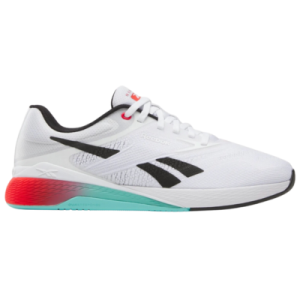
Reebok Nano X5
Construction Details
Upper
The upper is constructed from a lightweight, double-layered engineered mesh running across the forefoot, midfoot, and heel. Reebok added an internal toe guard that wraps the perimeter of the toe box, which significantly reinforces structure and lateral containment.

The lacing system consists of six core eyelets with a seventh eyelet for lace-locking, providing good midfoot tension. The padded mesh tongue features an internal gusset and lace loop that prevent mid-workout slippage. While there is no external heel pull-tab, the contoured heel collar provides a structured cup that locks the rearfoot in place without excessive padding bulk.
Midsole
The midsole utilizes a full-length EVA foam compound tuned on the softer side for shock absorption. It features a higher heel-to-toe drop designed to facilitate forward movement and cushion jumping impacts, making it well-suited for interval cardio and class-style training rather than maximal load lifting.

Outsole
The outsole features a full rubber lug pattern extending across the forefoot, midfoot, and heel. Reebok redesigned the flex groove placement, replacing the harsh forefoot breaks of the previous version with a smoother, segmented tread layout that improves durability and natural foot flexion during burpees and sprints.

Final Remarks: Is the Reebok Nano Gym 2 Worth It?
The Reebok Nano Gym 2 is a substantial improvement over its predecessor. By adding internal toe box reinforcement to fix lateral containment, smoothing out the outsole flex grooves, and delivering a responsive, cushioned ride, Reebok has turned this into a dependable generalist workout shoe.
If you keep your lifting under 275 lbs and spend most of your gym time doing metcons, box jumps, kettlebell work, and cardio intervals, the Nano Gym 2 offers solid versatility and comfort.
If you have additional questions about how the Reebok Nano Gym 2 fits, handles specific movements, or compares to other budget trainers, feel free to drop a comment below!



Add a Comment