

I’m going to try and write this review as objective as possible, but full disclosure, the Forged & Tested Catalyst is MY shoe, AKA the training shoe that I built. It feels surreal to be saying that after reviewing shoes for pretty much a decade, I’ve built my own trainer.
It took me 18-months to get this training shoe “just right” and I’m still making small tweaks to it as I go to improve its performance and aesthetics. If you want to learn about its innovation and all of the prototypes it took, check out my Catalyst development page.
The Forged & Tested Catalyst is a training shoe that’s built to be the perfect intersection between a modern-day trainer, like a Metcon 10, and a barefoot shoe for training, like the Vivobarefoot Motus Strength 2. I felt there was a gap in the market for a wide, true transitional cross-training shoe, so I built one.
To support my objectivity in this review, I’ll be sharing other buyers’ reviews and I’ll do my best to keep my thoughts unbiased, but I will share some of my logic and opinions throughout. At the end of the day, I’ll be the first to tell you that I didn’t build the Catalyst for everyone and not everyone will love these, and that’s okay.


Forged & Tested Catalyst
$125

Pros
- Great for Minimalist Lovers
- Grippy Outsole
- Lightweight and Flexible
Cons
- Pass If You Want Ample Arch Support
- Not the Best for Longer Runs
Best For
- Lifting
- Cross-Training
- Wide Feet
- Minimalist Lovers
- Sprints/Short Runs (<1k meters)
Specs
| Heel-to-Toe Drop | 3mm |
| Weight | 11 oz (size 10) |
| Width | Wide |
| Lifting Threshold | ~505 lbs |
| Run Distance Threshold | <1k meters (at one time) |
Who Should Buy the Forged & Tested Catalyst?
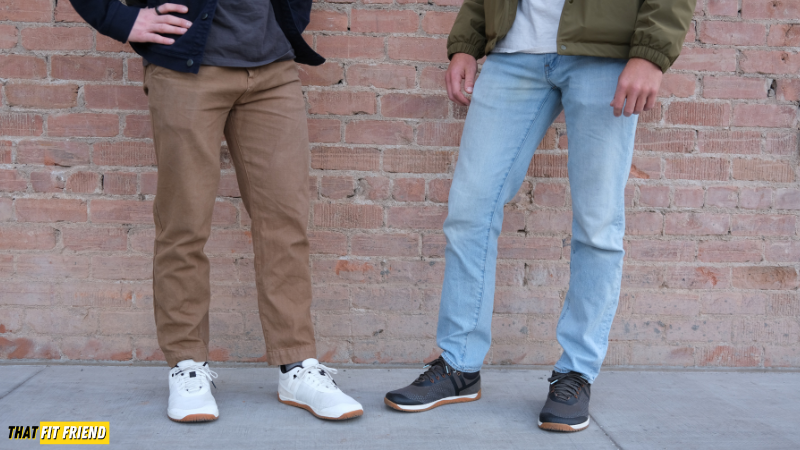
- Minimalist shoe lovers. The stack height of the Catalyst sits at 15mm in the forefoot and 18mm in the heel. This gives you a barefoot feel with some midsole for comfort and support. Compared to other trainers, this puts the Catalyst on the super minimalist end of the spectrum.
- Wide and flat feet. I built the Catalyst to work for narrower feet and foot widths up to 4E. I did this by specifically tuning the upper and midfoot security to provide lockdown for a wide range of anatomies. These are also great for flatter feet athletes who can’t stand a ton of arch and artificial support in their shoes.
- You like flexible, lightweight shoes. The Catalyst with its minimal stack height has a ton of flexibility and it’s on the lighter side for trainers. I tried to build this shoe in a way that makes you forget you have them on your feet.
- You want a shoe for lifting and athletic workouts. For lifting, the Catalyst is built to be super stable and its well with the feet for jumping and multi-directional work due to its flexibility and grip. As for lifting, I’ve deadlifted over 500 lbs and have squatted over 315 lbs in this shoe without stability issues.

Who Shouldn’t Buy the Forged & Tested Catalyst?
- Arch support lovers. If you seek out shoes that have a ton of arch and midfoot support, tread lightly with the Catalyst. I didn’t build this shoe for this type of footwear ask and if you do try them, expect a flatter feel on the foot.
- You love a lot of cushion. These are minimalist, which means you’ll “feel” the ground more when training in them. If you’re after super cushioned trainers, don’t buy these. There are plenty of great options for that ask and the Catalyst won’t be one of them. Granted, if this is you, I think you could benefit from some stack height variability, but that’s for another conversation.
- You need a trainer for running, too. The Catalyst can work great for shuttle runs, sprints, and intervals under 1k, but if you’re not used to minimalist shoes, it won’t be your best hybrid trainer for logging a ton of miles. Granted, if you’re normally in barefoot shoes and you’re here for something with a little cushion, then you’ll probably love the Catalyst for running. I’m speaking more to those who prefer more foam under foot when tackling hybrid workouts.
Fit and Sizing
About My Feet: I have a normal arch/instep and my feet come in at an E/EE width. The length of my left and right foot are consistent with one another, and I size as a true US 10 for most companies’ sizing charts.
My sizing suggestions:
- Narrow (<D) feet: True to size
- Medium (D) width feet: True to size
- Wide (E/EE) feet: True to size
- Extra Wide (3E+): True to size

I built the Catalyst’s length to follow companies like Nike’s sizing chart to give athletes a fair starting point. In the Catalyst, most athletes and lifters, regardless of foot width, will be safe going true to size. Basically, go with your normal size from big brands like Adidas, Nike, and Reebok.
If you’re a half-size and have medium width and wider foot, go up. For my notably narrow footed friends, go down. Sizing up is always the safer bet, though, if you’re in-between sizes.
For my flatter footed friends who love a shoe without a ton of arch support, I think you’ll love this shoe. I built them to allow the feet to move freely and allow for some natural pronation to occur when training, which is something way too many training shoes limit these days, in my opinion.

Performance Review: What Others Have Said
There are reviews pulled directly from the Forged & Tested Catalyst product page. For the record, Hunter and Chris were two of my first customers and are two athletes who have worn A LOT of shoes, so I put a lot of weight into their feedback.
Chris L
I was lucky enough to test out the first retail pair of the Catalyst, and honestly, they were even better than I expected, and I expected a lot. I’ve been coaching for over 10 years and have trained in almost every training shoe released during that time, with some of my favorites being older Metcons, Haze Trainers, and Rads.
These are easily one of my favorites, if not my all-time favorite. A few highlights: Fit: They broke in after about two sessions and then fit like a glove. Once you get moving, you almost forget you have them on. I have also worn them on the floor coaching for multiple hours with no issues whatsoever.


Performance: They are extremely stable for lower-body lifts, light enough to feel nimble for plyometrics, and the grip is insane. I normally do not think of grip as a major factor, but these grip rubber gym floors better than any shoe I have ever worn.
Jake made a great point that it might take a few sessions for your feet to adapt to a more minimal shoe, and after about two to three sessions, my feet felt great in them. Build & Value: For the price, they can’t be beat. The materials feel top-notch, and nothing feels flimsy. With how the training shoe market is trending, these feel like a steal at this price point. You can tell these were made by someone who actually trains, and I really appreciate that Jake takes feedback seriously and looks to continue to improve the model. These will be my go-to training and travel shoes from here on out, as other shoes just do not feel as comfortable anymore. Now I just need Jake to make more colorways so I can stock up.
Hunter R
I’m one of the lucky few that got to test these shoes prior to pre orders shipping out. The Catalyst nails what it was made for. You get the best of a training shoe and the benefits of a minimalist style shoe. The Catalyst is flexible throughout the entire shoe but also incredibly stable for your lifts. Ground feel is fantastic without going full on barefoot shoe. The lockdown helps your foot feel secure especially during change of direction or where there’s a lot of demand regarding range of motion.

They are lighter than most trainers on the market which is a big plus. Sizing I found to be spot on. I wear a M10 in most shoes so these were right on the money. The Catalyst is a strong entry into the market of training shoes and provides a new experience for those who want the comfort/durability of a training shoe with the benefits of a minimalist shoe. I highly recommend these shoes. They are now my go-to trainers!
Katy K
Full transparency: I’m Jake’s girlfriend, so yes- this is a 5-star review. That said, before wearing the Catalysts I had never worn a minimalist shoe, so I hope this perspective is still genuinely helpful. For context, my primary focus in the gym is strength training and conditioning. I often train with Jake, but I also sprinkle in classes like F45 and Barry’s, along with weekly outdoor runs.
Depending on the workout, I’ll typically wear Nike Metcon 6 (size 7), TYR CXT-2 (size 8), or Brooks Anthem 6 (size 7.5). I wear the Catalyst in a size 7.5, and they fit perfectly. If you’re between sizes, I’d recommend sizing up. Things I noticed while wearing the Catalyst: -Whenever Jake and I train together, he’s always telling me I need to be better about “engaging my big toe.” Before wearing these, I consistently put most of my weight into my heels during lifts.


I chalked this up to years of Reformer Pilates [IYKYK] which probably played a small role- but after wearing the Catalysts, I’m realizing my shoes were a major factor. The flexibility, 3mm heel-to-toe drop, and wide toe box allow my toes to spread and engage, making me feel more planted and secure during movements like squats and deadlifts. This has noticeably improved my form and even allowed me to increase weight. -They’re easy to slip on and off without constantly tying and untying laces, and without collapsing the heel or sacrificing foot security. -I have fairly narrow feet and was initially worried these would look too wide on me aesthetically. Thankfully, that wasn’t the case at all.
I’ve worn them both to the gym and casually with jeans and yoga pants, and they look great. -We’ve logged a lot of walks in these. No heel slipping, no blisters, and no real break-in period- they’ve molded to my feet incredibly well. While Jake wore these for both of our HYROX races, I personally wouldn’t use them as running shoes. They really shine as strength-training and everyday wear shoes.

TL;DR: If you’re new to minimalist shoes, I highly recommend giving these a try. It may take a day or two to adjust to the feeling of these compared to more narrow/cushioned shoes, but I’ve already noticed improvements in my foot strength and overall foot health, which has translated directly into better training habits.
Construction Details
I built the forefoot and midfoot upper of the Catalyst with a layered chainlink mesh. This mesh is designed to breathe decently well while morphing to your foot. I wanted it to feel almost sock-like on the foot so you forget you have them on.
There’s a haptic overlay the covers the upper for additional durability and lockdown. This material is designed to move with the mesh and serve as a first layer of support for abrasion resistance. I tested a lot of different print thickness to see which was the most durable, and the print that was layered 11 times won out.


The forefoot features a reinforced TPU that breaks just before the forefoot to prevent any issues with lipping or delamination. There’s also a TPU layer that surrounds the midfoot. I used the loop eyelets and tuned them to assist with lockdown and to promote security for multi-directional movements. These help contribute to why the Catalyst can work for narrower feet despite being a wider shoe. The tongue has a gusset and is padded to maximize comfort, the Jason Tatum basketball shoe’s tongue inspired this feature.
The boot is composed of a reinforced suede and chainlink mesh. I tuned the boot so you can wear the Catalyst looser and slip your foot in without compressing or bending the heel. This contributes to this shoe’s daily wearability and the “FT” TPU layer adds as an additional layer of reinforcement to prevent the boot from separating or losing its structure.
The FlexCore midsole is custom-tuned to provide you with a nice degree of bounce and comfort, even though this is a lower stack height shoe. It took me 15-months to perfect the tuning of this midsole. The outsole features a herringbone tread with 1.45mm deep lugs. This outsole was inspired by basketball and court shoes and the rubber is tuned softer to maximize grip on all surfaces — much like a basketball shoe.

The insole is removable and is 2.5mm thick. The bottom features an “X” design and pattern to prevent sliding in the shoe when training.
Final Remarks
The Catalyst took me 18-months to build and I’m proud of how its performed as a first pass. It’s the FIRST shoe that I’ve ever built and designed and it will only improve.
If you’re someone wanting a good “all-in-one” training shoe that lives between a barefoot and modern-day trainer, then you’ll love the Catalyst. It’s hyper flexible, tuned for comfort, and is lightweight on the feet to make you forget you have them on.
They can be a solid option for most foot anatomies, especially wider feet and flatter feet who don’t love having a ton of arch support.
For my folks who love more built-out shoes and platforms, the Catalyst likely won’t be your best option. However, having them in your rotation to train your feet wouldn’t be a bad idea.
If you have additional questions, drop a comment below!


Josh S
Jake, I just wanted to say thank you. I’ve been following That Fit Friend for years, and watching you go from honest shoe reviews to launching your own shoe has been one of the most inspiring creator journeys I’ve witnessed. You never chased the algorithm or did pay-for-play content. You built real trust, and your authenticity shows.
Dang, you just gave me goosebumps. I appreciate you saying that! Slow and organically while marching to our own beat — that’s the goal! Thank you so much, Josh!
Matt
Hey Jake,
Your new Catalyst shoes look amazing for gym workouts. I actually just picked up a pair of Born Primitive Savage 1 Classic low tops. The toe box width is great, but I had to exchange them for a half size up since I needed a bit more length.
I opted for the low tops because I wanted something easier to lace up and take on and off. I also love that the new BP Classics have a nice plush padded tongue, unlike their original low tops. I almost went with their high tops—they’re old school and look great—but I prefer the freedom of ankle movement during my compound lifting routine.
I love the hard sole on the BPs and can’t wait to use them for heavy squats and deadlifts. I’ll definitely keep your Catalyst shoes in mind for a future pair—I just need a size 13, which you don’t have in stock yet.
Thanks for all your great reviews. You’re my go-to reviewer for strength and cross-training shoes.
Ay, glad they’re working out for you, homie!
The Catalyst will feel a bit different on the feet, so I’m excited for your thoughts when you pick up a pair. I should have a restock in late May, then another drop of new colors come summer! Appreciate you sharing your feedback and for your support, brother.
Shane
These look perfect, when will you be getting more in stock?!
Hey, homie! Thank you for the kind words on the shoes.
Hopefully, late April/early May on the initial colors. I also have two NEW colors in the works that should hopefully arrive late May? TBD — always a little tough to gauge timelines when still in the approve colors/pre production phase.
Victor Jimenez
Jake, please come out with a triple black colorway
All in due time!