

That Fit Friend is reader-supported and may earn commissions through affiliate links. We also work with select brands on paid editorial partnerships. These relationships do not influence our testing methodology, product ratings, or recommendations. Read more here!
The Project Rock line from Under Armour has been an interesting line to follow. It’s had a decent ebb and flow over the years. Some of them have excelled, and others have disappointed (*coughs Project Rock 3*).
I personally liked last year’s Project Rock shoe line. The Project Rock 7 delivered a strong performance, and its little brother, the Project Rock BSR 5, stood up to most tests well.
When Under Armour released the Project Rock 8, I was cautiously optimistic. It came as a bit of a shock when I saw that they dropped the price by $20. Why the drop? Does this mean Under Armour skimped out on materials, or that this shoe was more of an afterthought this year, as the prep for the new TriBase Reign models?
My main concern was that the lower price point correlated to a cheaper feel and a step backwards in terms of performance. Here’s my interpretation.
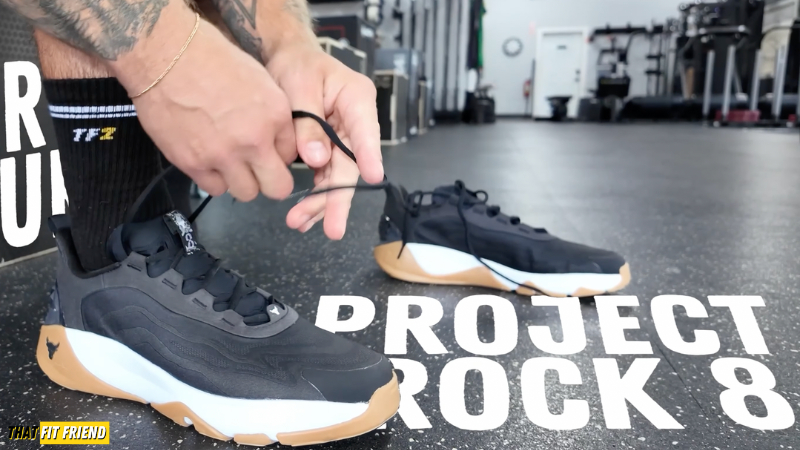

UA Project Rock 8
$140

Pros
- HOVR midsole is stable
- Good ankle support
- Well-rounded in gym
Cons
- Fairly heavy trainer
- Upper lacks that PR "zest"
- Heel can feel clunky
Best For
- Recreational Lifting
- Cross-Training
- Arch Support Lovers
- Athletes Who Like “More” Shoe
Specs
| Heel-to-Toe Drop | 6mm |
| Weight | 13.5 oz (size 10) |
| Width | Medium |
| Lifting Threshold | ~455 lbs |
| Run Distance Threshold | ~800m (at one time) |
Who Should Buy The UA Project Rock 8?
- You Like Built Out Shoes: If you like the stiffness and higher stack height of the Project Rock line but want something with a little bit of flexibility, the PR8 is worth taking a look at.
- You Like Ankle Support: If you struggle with heel slip and want something with more ankle support, you’ll love the reworked heel and boot in the PR8.
- You Love Project Rock Shoes: If you’ve been a Project Rock fan for a long time and have been turned off by some of the recent models, the PR8 is a step in the right direction and worth checking out.


Who Should Pass On The UA Project Rock 8?
- You Want Cross-Functionality: If you want a shoe for daily wear that you can also wear to the gym, this isn’t going to fit the bill. It’s purpose built for training and is too clunky for everyday use.
- You Like Lighter Shoes: If you’re looking for a lighter weight shoe with more ground feel, the stack height and lack of flexibility in the heel are going to make this a pass for you.
- You Have 3E+ Width Feet: If you have exceptionally wide (3E and up) feet or have a thicker instep, the overall width and lack of upper volume is going to make this shoe restricting and uncomfortable.
Sizing & Fit Suggestions
About My Feet: I have a normal arch/instep and my feet come in at an E/EE width. The length of my left and right foot are consistent with one another, and I size as a true US 10 for most companies’ sizing charts.
Fit Width Breakdown:
- Narrow (<D) feet: True to size.
- Medium (D) width: True to size.
- E and 2E: True to size, but expect a snug fit.
- 3E+: Pass altogether.
The length in the Project Rock 8 is spot on. Size them like your other Under Armour shoes or Nike and Reebok trainers. If you already wear Project Rock shoes, stay with your current size and you’ll be just fine. You’ll be fine staying true to size for anything from narrow through 2E foot widths.


Anything 3E and up, you’ll want to pass on this one. I have a 2E foot width and found myself pushing pretty hard against the side wall of the shoe on some lateral movements. Thankfully, the reworked upper is forgiving and secure enough that it wasn’t an issue. If my foot was any wider, it’d be a concern.
The upper volume is also pretty limited. If you have a thicker instep or blockier foot, it’ll feel constricting through the forefoot and midfoot.
Also, if you have a flatter foot, the midsole and arch will be an issue for you. It’s not a complete dealbreaker, more of a try before you buy. Move around a bit at home, do some lunges and hops, before taking them out for a full workout and be ready to return them if they’re uncomfortable. There’s virtually no break-in period for the midsole. They come out of the box ready to roll, so if they don’t feel good right away, they’re not going to get better.
Performance Assessment
Lifting: 8.1/10
These are a solid lifting shoe. Honestly, I would expect nothing less from a shoe with the Rock’s endorsement. Despite the high stack height, they felt stable on deadlifts up to 405 lbs.


The reworked TriBase tread in the midsole adds a nice amount of stability through the midfoot and heel. Paired with the improved ankle support and boot construction, I felt locked down and secure through every lifting test I put them through. I made a point to test them for machines and free weights.
They still have that same stiffness and grip that has become typical of the Project Rock line. Squats and heavy machine work felt very secure and solid. For anything strictly strength-related, heavy barbell work, lighter dumbbell and accessory work, and machines, the Project Rock 8 is a solid shoe.
Cross-Training: 8/10
These have been surprisingly lively and enjoyable for cross-training. They’ve got enough bounce and fun to them for short intervals on the assault runner, ski erg, and sled work.
The improvements made to the outsole and ankle really shine here. They broke up the tread in the forefoot giving it more flexibility than its predecessors. The reworked TriBase tread in the midfoot made it a bit more stable for lateral work. And the reworked boot with the outsole wrapping up both sides and the TPU layer on the heel helps prevent the PR8 from sliding on the ankle. It was incredibly secure through sled and assault runner circuits with no heel slip.


It is a narrower shoe than I prefer. Once I started moving laterally and getting explosive, that became a bit of an issue. I noticed myself really pushing into the side wall during lateral sled drags, explosive side-to-side jumps, box jumps, and broad jumps. It wasn’t terribly uncomfortable, and thanks to the improved synthetic layer on the toe-base, there was no awkward rubbing on my pinky toe. The upper did a good job of keeping me secure despite my best efforts to explode out the side of it. I do think that it’ll break in a bit over time and be a bit more forgiving.
Short Runs: 7/10
Honestly, I don’t see myself running in these outside of the gym or for anything longer than a 400 or 800 meter interval as part of a circuit. For these distances, they’ve been fine and can work, but with their bulkiness, I wouldn’t run much longer than those distances in them.

For example, if you’re the person who likes tackling some quick runs pre and post-workout for warm-ups, then you’ll be fine in these. I would NOT use them for the lifter who likes tackling 2-3 miles each workout. For that, you’ll want to look into more hybrid-focused training shoes or bring a running shoe swap for better ride comfort and performance.
If you need a running shoe recommendation, I’d highly suggest looking into the Adidas Adizero EVO SL. They’ve been awesome and could be the perfect pairing with your PR 8s.
Daily Wear: 6.5/10
I’ve mentioned it a couple times already, these are a heavier shoe and they’re purpose built for the gym. If you love them and find them comfortable, you’ll probably be fine wearing them as a daily shoe, especially if you like more built-out shoes with wider midsole platforms.

I personally don’t. They’re a bit too narrow for my liking and the lower forefoot volume starts to feel limiting for multi-hour use. The heel is also too heavy and stiff for what I want out of a daily driver.
Construction & Materials
These weigh 13.5 oz (men’s size 10 US) and have a heel-to-toe drop of 6mm, and they do not have a removable insole.
The outsole extends up the toe for extra protection and durability. The upper is a single piece of mesh that runs from the forefoot through the midfoot and features suede overlays which reduces breathability. There is a synthetic overlay on the toe box that ends well before the forefoot crease, preventing any restriction at toe flex.


The boot is a padded mesh and extends slightly up the heel. There is a heel tab to help with pulling them on. The heel has a TPU overlay that extends up the back of the shoe adding support and structure to the reinforced ankle.
There are 4 core eyelets running up the midfoot. The tongue is made from a neoprene material similar to knee sleeves, and it is gusseted. The tongue also features a loop at the top to help with pulling them on. The tongue is shorter and narrower than it needs to be, and can easily fold when putting them on. Between the awkward tongue and thicker, stiffer upper, the PR8s don’t slide on and off with ease.

Underneath, there is a rubber outsole that extends up the medial and lateral side of the heel. It features extra breaks in the forefoot for added flexibility. The TriBase tread in the midfoot extends further back into the heel than the PR7, for added stability and features the signature bull in the center of the tread. The tread does leave part of the midsole exposed, raising some concerns for long-term durability if its exposed to too much water or outdoors.
The midsole is UA’s HOVR midsole and runs throughout the length of the shoe.
Final Thoughts: Would I Buy Again?
I liked the Project Rock 7. It wasn’t a perfect training shoe, but I could see and appreciate where it excelled in terms of performance. For a shoe line that has had its shares of ups and downs, I’m pretty happy the Project Rock 8 is a step in an okay direction.
Maybe not a full step forward, but still not a step backward from the PR7 — especially when you consider these cost less.
It is refreshing to see a shoe company update its shoes and reduce the price point without tanking performance, though. And for that, I’ll give the Project Rock 8 some kudos.



Add a Comment